Category: Public Safety28.09.2026
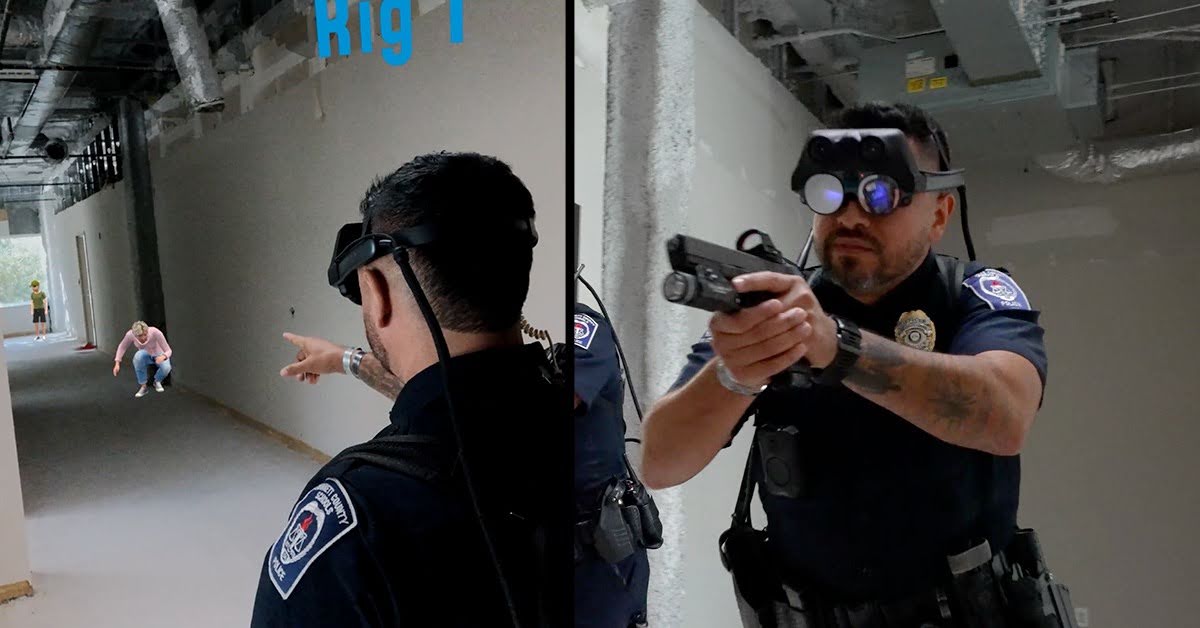
School Resource Officers (SROs) require highly specialized active shooter training in order to keep learning spaces safe, but traditional scenario-based training has too many limitations (cost, logistics, realism gaps). Augmented reality (AR), AI, and immersive tech have thankfully risen to meet these challenges and allow for higher realism, safer repetition, and better decision-making for campus-based threats.
Traditional active shooter training comes with a lot of costs and high scheduling requirements for in-person drills. There are also naturally various physical risks to officers during force-on-force training. Such systems also make it difficult to simulate large school buildings, hallways, and classrooms.
Shooter training that doesn’t use AR also has trouble simulating multiple threat types, and this resulting repetition can become too predictable to be useful. It can also make it difficult to accurately measure the stress response of SROs involved in each scenario.
Thanks to technological advances, AR can create realistic and sensory-rich environments so that officers can practice under stress, noise, and time pressure. Repeat training using AR modules enables effective stress inoculation for traumatic, fast-moving incidents.
AR also offers realistic branching scenarios with multiple outcomes and allows for instructor-controlled threat behaviors and environment changes so that SROs can learn and adapt to a wide variety of situations. There is even the potential for AI-powered scenario evolution based on officer actions.
Training with AR is also useful because of the many performance metrics available, including reaction time, accuracy, movement, and communication. Biometric stress tracking is also available for factors such as heart rate, gaze, and posture. Such deeper after-action reviews are simply not possible with traditional active shooter training.
One of the best cases for AR use in active shooter prep is the building of virtual replicas of classrooms, cafeterias, gyms, and hallways featuring practice room entries, stairwell tactics, and evacuation support. Multi-floor navigation drills are even possible using these school-specific terrain models.
The repetition of AR training helps SROs identify real threats vs. non-threats (students, teachers, staff), make critical shoot/no-shoot judgment under pressure, and create de-escalation opportunities before force is required.
Advanced systems also allow for teams to collaborate inside shared AR environments so that communications, clearing procedures, and contact/cover roles can be clearly covered. They will also be able to fully integrate with dispatch or command guidance.
AR training also helps manage student and staff evacuations, teaches SROs to identify injured or trapped individuals, and allows for them to practice securing the scene post-neutralization.
InVeris’ fats® also provides ballistic-accurate weapons training using recoil-enabled weapons with lifelike physics so that judgmental and marksmanship training can be combined for customizable school-based threat scenarios.
InVeris also offers tailored simulations for specific school layouts where you are able to recreate hallways, classrooms, gymnasiums, and auditoriums and incorporate in local protocols (e.g. lockdown, shelter-in-place).
These systems also track accuracy, response time, and verbal commands as well as provide biometric stress indicators. Instructor-driven AAR dashboards are also designed to help drive performance improvement.
InVeris allows for multi-officer, multi-location training that is able to coordinate with real-world equipment and integrate with school district safety drills.
AI and machine learning enhance AR training through real-time adaptation of suspect behavior, dynamic threat escalation or de-escalation, and data-driven officer performance recommendations.
Wearable devices also monitor physiological response during crisis simulations, thus correlating stress with decision-making accuracy.
Integrating drones and other robotics can be used to simulate UAV reconnaissance during active threat incidents, train officers on robot-based clearing and threat detection, and coordinate solutions using both ground units and robotic support.
AR is an incredibly cost-effective alternative to frequent in-person drills as long as the hardware and facility requirements are met. Mobile AR units are also an option for multi-campus districts.
Trained operators are needed to implement AR training, and curricula will need to be aligned with local procedures and integrated into ongoing SRO training cycles.
AR training provides scalable solutions for both small and large school districts and provides consistent training regardless of officer experience level.
Blended learning systems can be formed by incorporating online modules for foundational skills, AR for immersive tactical decision-making, and live drills for physical movement and team coordination.
Blended training is the future of active shooter training because it is flexible, scalable, and repeatable. This model trains cognitive skills and physical readiness while building long-term confidence and resilience.
Augmented reality is transforming how SROs prepare for the most dangerous school incidents, and systems like fats® deliver unmatched realism, analytics, and adaptability. The future of SRO training is immersive, data-driven, and safer for both officers and students.

Fill in the form below and we'll send a link for you to download the White Paper to your inbox.
Fill in the form below and we'll send a link for you to download the White Paper to your inbox.
Fill in the form below and we'll send a link for you to download the White Paper to your inbox.