Category: Military24.09.2026
As the rise of drone threats increases across almost all modern conflicts and we see the limitations of traditional Counter-UAS (C-UAS) training, major defense agencies should turn to augmented reality (AR) for anti-drone readiness. In this article, we will discuss how AR accelerates decision skills, recognition, and engagement in drone environments.
Drone threats are quickly evolving into smaller, faster, and low-flying devices used for a range of surveillance, targeting, and strikes. Recent conflicts, such as the war between Ukraine and Russia, has made clear the need for increased technological sophistication.
Conventional C-UAS training is also limited by regularly restricted access to airspace for live practice, the increasingly high cost of drones, munitions, and electronic warfare systems, the innate safety risks of live intercept exercises, and the lack of repetition in unpredictable drone scenarios.
AR helps train against multiple drone types, sizes, speeds, and flight behaviors, and there is advanced recognition training for FPV (first-person view) drones, quadcopters, and fixed-wing micro-UAS so that both hostile and non-hostile drones can be identified.
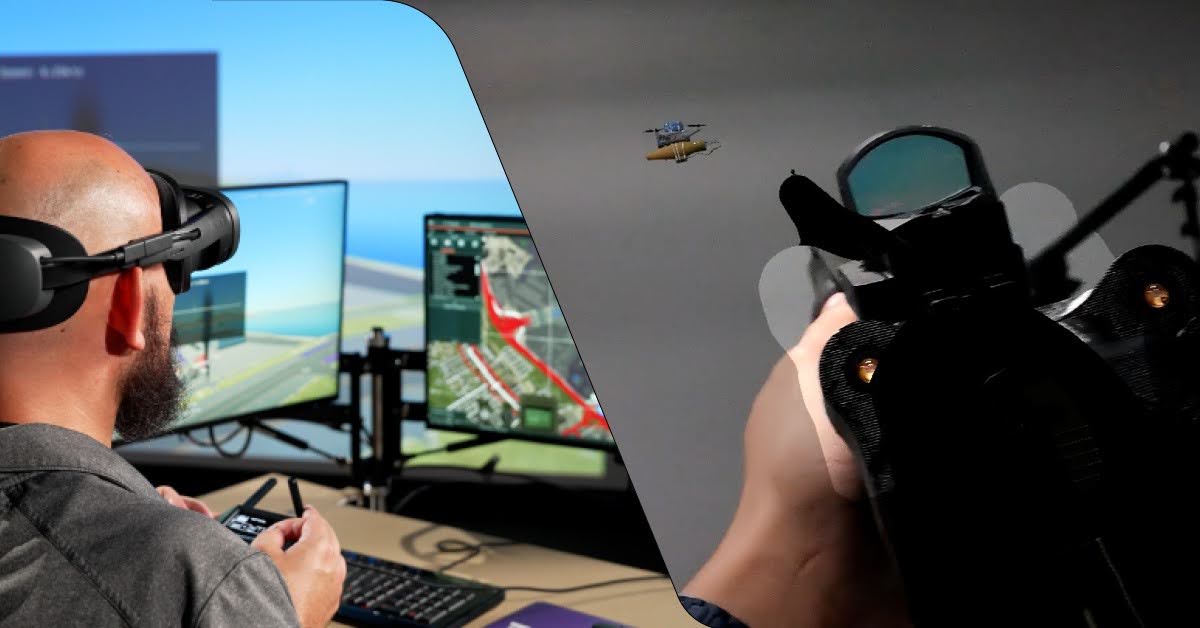
AR can also simulate jamming, signal disruption, or responses so that soldiers can work on timing, aim, and tracking accuracy as well as handle split-second target acquisition. Troops simply put on the AR glasses to see the simulated drone in the real environment and then shoot it with a Bluefire weapon.
AR can be used to train for scenarios involving fog, night ops, low-visibility, and contested terrain by simulating realistic weather, noise, and battlefield pressure within urban, forest, and open-terrain scenarios.
AR will track reaction time, target tracking accuracy, decision-making under stress while helping soldiers with cognitive load and situational awareness.
InVeris’ fats simulators offer ballistic-accurate weapons simulations for C-UAS interception. They utilize recoil-enabled weapon hardware and physics-based drone movement models. Instructors using these simulators can adjust threat speed, altitude, and angle at all times.
InVeris’ counter drone system is built on OneArc’s VBS4 platform, and it lets troops fly simulated FPV as well as other small drones within a shared digital space. This technology allows them to practice counter-drone strategies, simulate reconnaissance and attack runs, and resupply drops.
The AR systems offered by InVeris are great for custom drone swarm simulations, FPV kamikaze drone scenarios, directed-energy training, and jammer device training while incorporating local terrain, missions, and operational challenges.
InVeris’ also has LVC multi-domain training that ties AR drone engagements into large-scale joint-force exercises. Soldiers using them can practice coordinating air, ground, and EW (electronic warfare) units while distributing C-UAS operations across bases.
The biggest benefit for using AR is that it allows soldiers to simulate high-risk scenarios without real drones or munitions while allowing for hundreds of repetitions so that muscle-memory can properly develop.
Using AR for military C-UAS programs allows defense agencies to quickly update according to new drone models and tactics.
AR systems are also much more cost effective than live-flight practice, are more accessible for small units, reserve forces, and allied militaries, and they are scalable for both multi-operator and multi-location exercises.
One of the most exciting future developments with AR is the creation of AI-generated drone swarms with adaptive behaviors. These integrated models would offer automated scenario complexity based on the user’s skill level.
Soon enough, AR will also allow for coordination between ground forces, UAV operators, EW teams, and command while incorporating real-time LVC integration.
The ultimate goal is to use AR and other extended reality technologies to create full-scale synthetic battlespaces that combine drone, cyber, and EW training environments. The better that AR technology gets, the more diverse and complex anti-drone training can become.
Drone threats are already actively reshaping modern warfare, and AR systems enable fast, safe, and scalable anti-drone training for all levels of defense. InVeris leads the way with their fats® and LVC-ready systems so that AR is not merely an enhancement—it is the next frontier in Counter-UAS readiness.


Fill in the form below and we'll send a link for you to download the White Paper to your inbox.
Fill in the form below and we'll send a link for you to download the White Paper to your inbox.
Fill in the form below and we'll send a link for you to download the White Paper to your inbox.