Category: Military04.02.2026
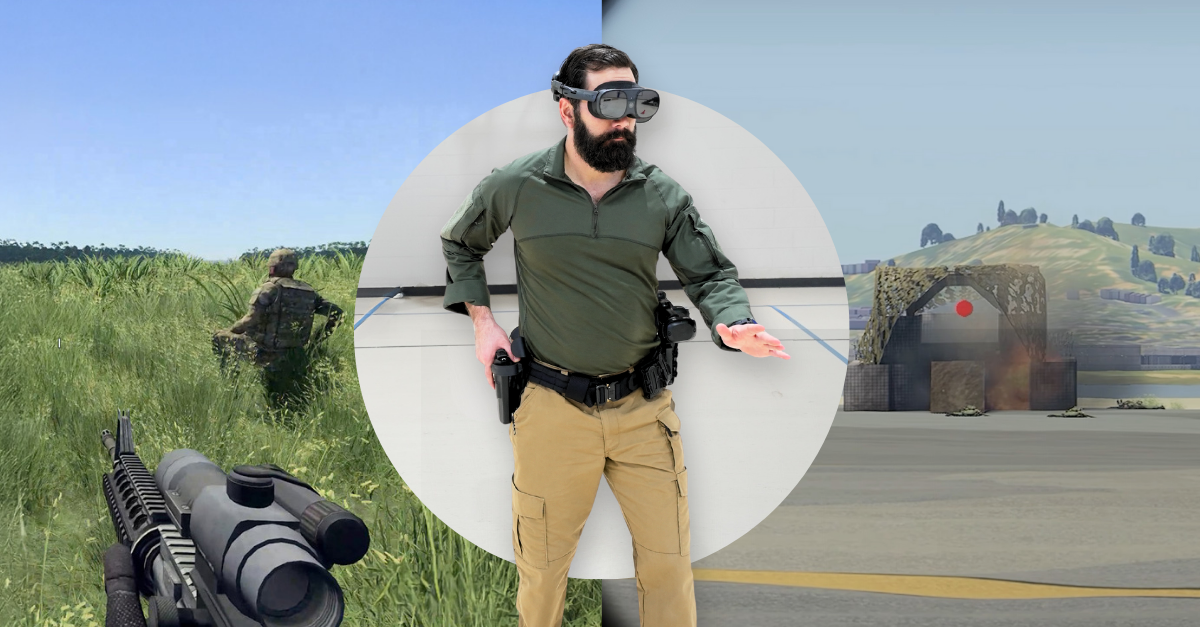
Virtual reality is fast becoming a central tool throughout the military apparatus due to its immense applications for national security and defense. All over the world, and particularly in America and its allies, militaries are investing in VR technology on account of its many use cases and applications in the contexts of military training. VR has grown from a relatively rudimentary training system into a sophisticated, immersive tool that can offer soldiers safe and realistic ways to train, and it is on track to improve even further in the coming years.
To examine how the military uses virtual reality, let’s begin with some of VR’s core use cases in military training:
VR has a number of applications for military combat and tactical training. With VR, soldiers can experience immersive virtual boot camps and squad-based drills. VR offers trainees authentic battlefield immersion that allows for real-time decision-making, and can be used to simulate a variety of diverse scenarios, from arctic warfare to urban settings and hostile zones.
Virtual reality is a safe and reliable training tool for pilots and vehicle operators. Military VR technology can provide pilot training with full-motion systems, as well as ground vehicle familiarization and cockpit ergonomics. VR can even offer a battlefield combined simulation, merging air, ground, and weapons simulations for comprehensive training.
With VR technology, military medics can safely train for critical in-combat medical scenarios. VR devices can support realistic Tactical Combat Casualty Care (TCCC) simulations with tangible but completely safe immersion. With VR, medical trainees can simulate practicing first aid under stress, enabling pressure-based decision training.
VR has immense potential for mission rehearsal and strategy. With VR, commanders can construct real-time war game simulations for their trainee units, allowing for collaborative command decision-making and environmental and terrain-based planning. Elaborate rehearsals can help commanders iron out key flaws in mission planning and produce better results.
VR also has many applications in equipment maintenance, design, and optimization, such as:
Virtual reality is a powerful tool for military maintenance crews who work on vehicles and equipment. VR can allow for the use of computer-aided design (CAD) models for system diagnostics and repairs. CAD and VR modeling allow for safe prototyping and operations in virtual environments, resulting in superior end products and reduced danger in the development process.
VR is a safe and effective venue for defense equipment design and testing. By providing haptic feedback and motion tracking in testing, VR can allow designers to evaluate tested equipment from a safe distance and with reliable results. VR offers valuable feedback loops for real-time iteration, allowing for better testing and superior operational efficiency.
With VR technology, military designers can collaborate like never before, even across great distances. Remote operations with VR technology permit extensive 3D model co-design for collaborations on complex tech such as submarines. Remote collaboration also permits secure, cloud-based immersive design reviews from multiple sources.
There are a number of advantages to the use of VR in military training, including:
Virtual reality offers safer, low-risk training environments for military trainees. VR eliminates the need for live fire or mock rounds in training while still offering realistic combat scenarios, keeping trainees safe and unharmed while providing authentic combat simulations.
VR allows military trainees to increase their skill retention via exposure to realistic scenarios. VR’s authentic simulacra of live-action scenarios offers better imprinting on trainee minds than memorization or non-immersive training, leading to better reflexes and retention.
Unlike older and more expensive training methods, virtual reality is a scalable and cost-effective military training tool. VR systems can be scaled up with much more ease than live-action training, and because they use digital systems, they cost less than expensive live-action training.
VR’s data-driven simulations allow training officers to receive and observe real-time feedback and performance analytics on their training operations. Commanders can use VR data to analyze each trainee’s performance, the skill of the overall unit, and potential areas of concern in the training regimen.
One of VR’s greatest advantages is its portability and accessibility. Because VR uses digital devices and systems, it can easily be transferred from homeland bases to military outposts in combat areas, allowing for on-site training that is easily accessible to deployed troops.
The future of virtual reality in military training is bright and growing, even when considering potential concerns. VR technology has numerous applications currently, and in the coming years, even greater applications for these technologies are on the horizon. Experts suggest that the future of VR military training will involve even greater integration of digital systems such as AI, augmented reality (AR), and cloud-based platforms for military exercises.
In addition to training, VR is projected to become an asset across the board in a military context. Suggestions indicate that VR technology is advancing into new forms, including wearable technology that integrates biometric data keyed to individual soldiers, modular, customizable training kits, and eventual VR mental resilience training.
Virtual reality technology is experiencing a boom in applications for military defense. The expanding role of these technologies promises to revolutionize the way militaries wage war, making training safer and hopefully resulting in better outcomes on the battlefield. VR is quickly becoming much more than a training tool–it is now a strategic asset that militaries around the world are flocking to and integrating into their operations.











Fill in the form below and we'll send a link for you to download the White Paper to your inbox.